
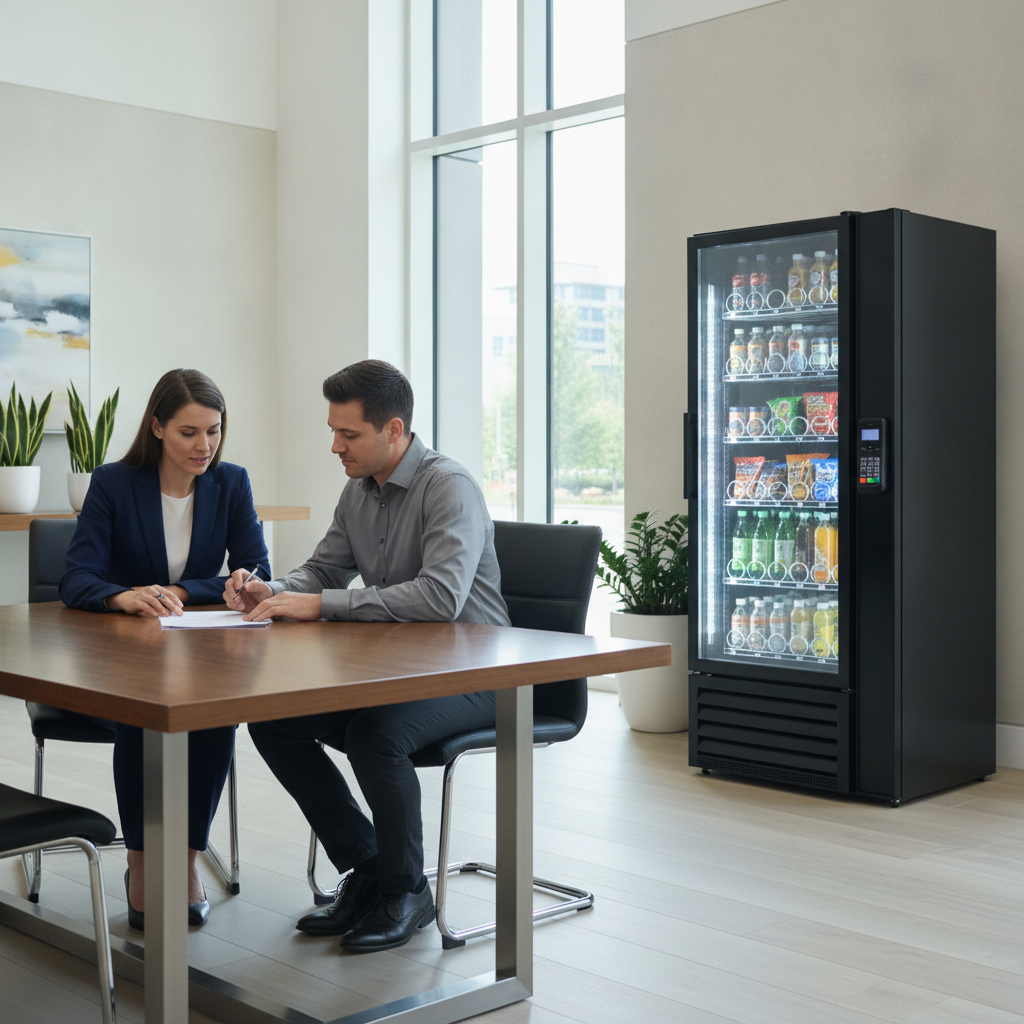
Reading the Fine Print Before You Sign a Vending Service Agreement
Most property managers I talk to across Bergen and Hudson County treat vending contracts like a formality. Sign the paper, get the machine, move on. Then two years later a tenant complaint comes in about a broken bill validator, and the agreement they signed says the operator has 10 business days to respond. That’s the moment they start reading the contract carefully — and by then the auto-renewal clause has already kicked in.
If you manage a mid-rise office in Fort Lee, a residential tower in Jersey City, or a mixed-use building in Hoboken, the vending service agreement you sign shapes tenant experience for years. Here’s what actually matters in that document.
The Clauses That Deserve Real Attention
1. Service Response Time (Not Just “Prompt”)
Words like “prompt,” “reasonable,” or “timely” mean nothing in a contract. Ask for a specific number. In our own agreements we commit to 24–48 hour response on service calls in the 30-mile radius we cover. If an operator won’t put a number on paper, assume the number is bad.
2. Restocking Cadence
A machine that runs empty is worse than no machine at all — tenants remember the disappointment. The agreement should specify minimum service visits per week or a stock-level threshold that triggers a visit. Modern operators using remote monitoring can commit to this because they see inventory in real time; older operators guess based on route schedules.
3. Exclusivity Language
Read this carefully. Some operators write agreements that prohibit you from adding a coffee service, a micro-market, or a second cooler on another floor unless it’s through them. That’s fine if you love the operator — restrictive if you don’t. Look for exclusivity that’s location-specific rather than category-wide.
4. Term Length and Exit Clause
New Jersey standard contract terms in this industry usually run 3–5 years with automatic renewal. That’s negotiable. I’d push for a 1-year initial term with 30–60 day termination for non-performance. If the operator is confident in their service, they’ll agree. If they insist on a locked 5-year term with no performance-out, that tells you what they’re planning to deliver.
5. Revenue Share vs. Free-Placement
Some agreements offer the property a percentage of sales. Others are free-placement with no revenue but no cost either. Neither is inherently better — but understand which one you’re signing. A revenue share of 5% on a low-volume machine in a 40-unit walk-up in Cliffside Park may generate less than $200/year while adding accounting overhead. Free placement with strong service often nets out ahead.
6. Product Mix Control
Can you request healthier options? Kosher-certified items for buildings in Teaneck or Englewood? Allergen-friendly snacks for a pediatric practice? The agreement should either grant you input on product mix or reference a published product catalog you can pull from. See our services overview for how we handle custom mixes.
7. Cashless Payment Guarantee
In 2025, an agreement that doesn’t specify tap-to-pay and mobile wallet support is a red flag. Cash-only machines cut sales roughly in half and frustrate tenants under 40.
8. Liability, Insurance, and Utilities
- Insurance: The operator should carry general liability of at least $1M and name the property as additional insured on request.
- Electricity: Standard practice in NJ is that the property provides the outlet and pays the electric — usually $8–15/month per cooler. Confirm this in writing so it’s not a surprise.
- Damage: Who pays if the machine damages the floor during installation or removal? Should be the operator.
9. Removal Terms
When the contract ends, who moves the equipment out and when? Get a specific window — 15 or 30 days after termination. I’ve seen buildings stuck with abandoned coolers for months because the departing operator didn’t have a truck available.
Questions to Ask Before Signing
- What’s your average service response time in Bergen/Hudson County?
- Can I see the last three months of service tickets for a similar-sized account?
- How do you handle refunds when a tenant loses money in a machine?
- What happens if I want to expand to a second location during the term?
A reputable operator will answer these without hesitation. If the sales rep dodges, deflects, or promises to “handle it later,” you have your answer about how service calls will go.
If you’d like a plain-English walkthrough of a proposed agreement — ours or a competitor’s — reach out for a conversation. Reading these documents is part of the job, and no property manager should sign one alone.