
Why Edgewater Condo Towers Are a Different Vending Problem
If you manage a residential tower along River Road, you already know the vending question isn’t the same as it is for an office building across the river in Midtown. Residents aren’t grabbing a snack between meetings. They’re coming home from a late shift, heading out for a run on the waterfront walkway, or looking for something at 11 p.m. when the Whole Foods at The Shops at Edgewater has already closed. The Edgewater Hudson River waterfront residential towers — from the buildings near Veterans Field down to the ones near the Edgewater Marina — have a specific usage pattern, and that pattern should drive what you install, where you put it, and what you stock.
We’ve been placing equipment in Edgewater buildings long enough to see what actually gets used and what sits as expensive decor in a lobby.
The Lobby vs. Amenity Floor Decision
Here’s a specific insight most generic articles won’t give you: in luxury high-rises, the single biggest driver of whether a resident amenity gets used is sight lines from the elevator bank. If a resident has to walk down a hallway, past the gym, around a corner to find a cooler, usage drops off a cliff — not because the walk is long but because residents forget it exists.
In Edgewater towers we’ve worked with, the sweet spot is usually one of these three locations:
- Just off the main lobby, visible when residents walk in from the garage or front entrance
- Inside or immediately adjacent to the fitness center — captures post-workout traffic, which is the single highest-converting resident moment
- On the amenity floor near the lounge or pool deck, especially in summer when buildings along the Hudson see heavy terrace use
What doesn’t work: tucking equipment into a package room or mailroom. Residents go in, grab their Amazon box, and leave. They don’t browse.
Why Smart Coolers Beat Traditional Equipment Here
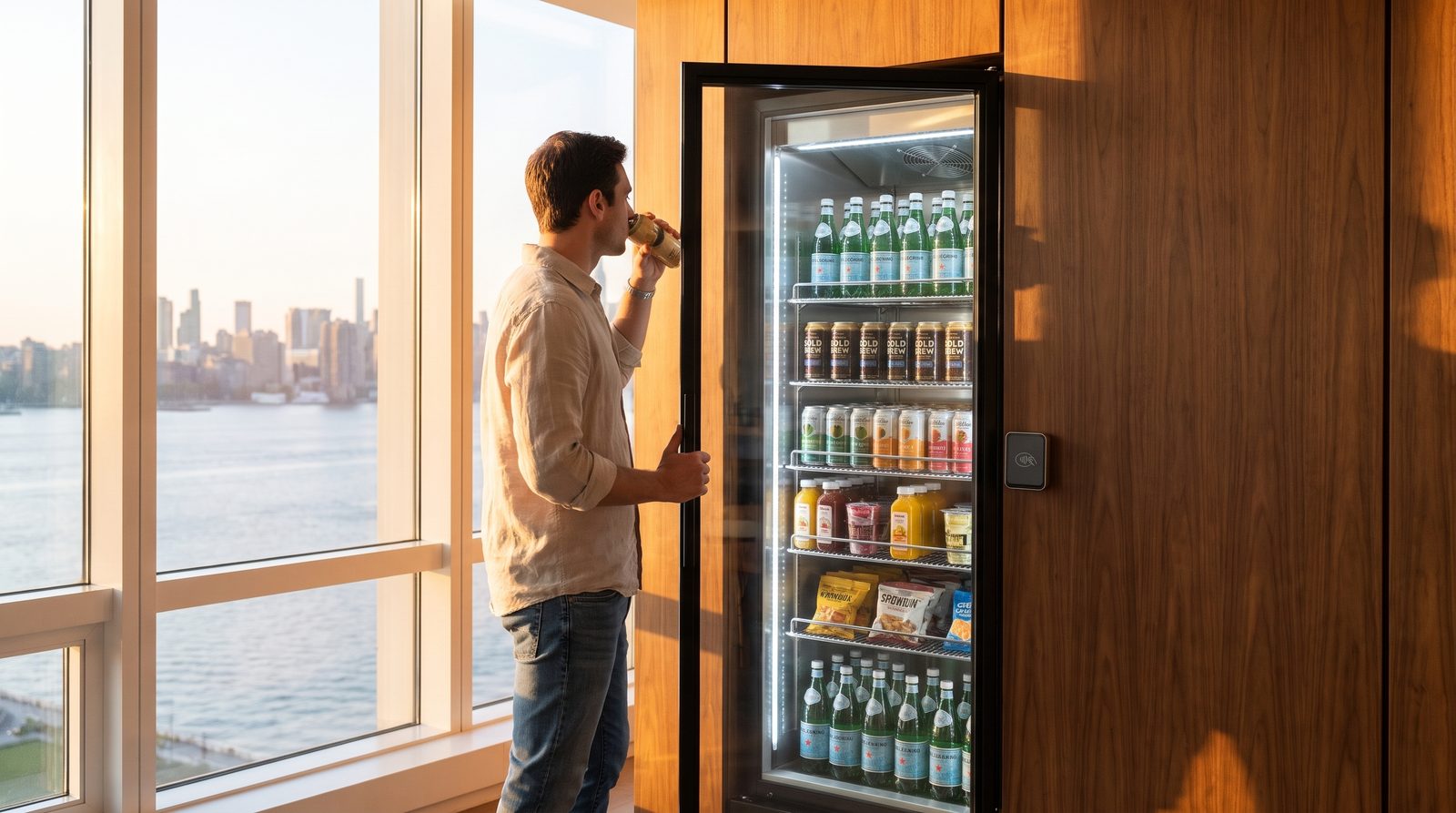
Luxury residential boards are, understandably, allergic to anything that looks industrial. A traditional vending machine with coils and a coin slot is a non-starter in a building where unit owners are paying serious money for finishes. A smart cooler — a clean glass-door refrigerator with a small tap-to-pay reader on the frame — reads as a high-end convenience store cooler, not as vending.
Operationally, it also solves a problem specific to residential: no cash handling. Doormen and concierges don’t want to deal with jammed bills or coin disputes at 2 a.m. Tap-to-pay with Apple Pay, Google Pay, or any contactless card eliminates that entire category of complaint.
What to Stock in a Luxury Residential Setting
Resident product mix looks almost nothing like office product mix. In Edgewater buildings we’ve seen the following patterns:
- Still and sparkling water move faster than soda — often 3 to 1
- Premium coffee drinks (cold brew, oat milk lattes) outperform energy drinks
- Better-for-you snacks — RXBARs, Perfect Bars, kettle chips, dark chocolate — sell at a premium that generic candy never hits
- Ice cream novelties are the dark horse — a small freezer paired with a cooler can add significant usage in summer
- Pet treats and single-serve pet food are a surprisingly consistent seller in dog-heavy buildings, and Edgewater is extremely dog-heavy
When to Step Up to a Micro Market
If your tower has 200+ units or a combined resident-and-staff population that supports it, a micro market on the amenity floor starts to make sense. This is an open retail setup — a couple of smart coolers alongside wood shelving for shelf-stable snacks and a single self-checkout kiosk. It looks like a tiny upscale market, not a breakroom.
Micro markets work especially well in buildings with coworking lounges, which more and more Edgewater towers are adding. Residents working from the lounge want fresh food options — yogurt parfaits, overnight oats, pre-made salads, sandwiches — that a single cooler can’t fully support but a market can.
What Condo Boards Should Ask Before Signing
- Is there any cost to the association? For a building of reasonable size, the answer should be no — equipment, service, and restocking should be fully covered by the operator
- How often is restocking? In residential, under-stocked equipment is worse than no equipment. Twice-weekly minimum for most towers
- Who handles resident complaints? There should be a direct line, not a 1-800 number
- Can the product mix be adjusted? Resident preferences in a Hudson-view luxury building are not the same as in a garden-style complex, and the mix should reflect that
Edgewater’s waterfront towers have raised the bar on what residents expect from building amenities. Vending — done right, with the right equipment and the right placement — can quietly become one of the amenities residents mention when they renew.