How the Office Snack Became a Workplace Institution
Every office has a snack story. Ask anyone who worked in a Midtown Manhattan law firm in the 1980s or a Hoboken brokerage in the 1990s, and they’ll describe a specific bowl, a specific vending machine, or a specific bagel Friday. The history of office snacks is really the history of how employers thought about employees — as clock-punchers, as talent to be retained, or as people whose afternoon energy dip actually affects the P&L.
The Candy Bowl Era (1950s–1970s)
The earliest office snack was the receptionist’s candy bowl — a glass dish of butterscotch discs, peppermints, or Hershey’s Kisses. It wasn’t there for employees. It was there for visitors, a small hospitality gesture near the front desk. Employees who grabbed a piece did so quickly, almost apologetically. The idea that a company should feed its workers beyond a subsidized cafeteria in a Newark corporate campus would have sounded absurd.
The Coin-Op Vending Wave (1970s–1990s)
As office towers went up along Route 3 and around Jersey City’s waterfront, break rooms filled with the machines most of us remember: tall metal boxes with spiral coils, dot-matrix price displays, and a coin slot that ate your quarters. The selection was narrow — Snickers, Doritos, a warm can of Coke if you were lucky. Nobody loved these machines, but for decades they were the only option for a 3 p.m. sugar fix in a Bergen County office park.
The Bagel Friday and Free Coffee Years (1990s–2000s)
The dot-com boom rewrote the rules. Startups in SoHo and Chelsea started offering free snacks as a recruiting tool, and the trend crept into more traditional NJ and NYC workplaces. Fridays meant bagels from H&H or a local Fort Lee deli. Coffee became free and, eventually, actually good. HR departments began treating snacks as part of the benefits conversation, not a nuisance line item.
The Pantry Explosion (2010s)
Then came the era of the fully stocked pantry — LaCroix towers, KIND bars, almond packets, cold brew on tap. It worked beautifully at well-funded tech firms in the Flatiron District, but it created two problems for everyone else. First, the cost was unpredictable and often ballooned. Second, waste was enormous: whoever ordered ended up guessing what 200 people wanted, and half of it went stale.
The Modern Era: Smart Coolers and Micro Markets
The current chapter fixes both problems. Instead of guessing, operators use connected equipment that tracks what actually sells. Instead of a locked box with limited selection, employees get an open retail experience.
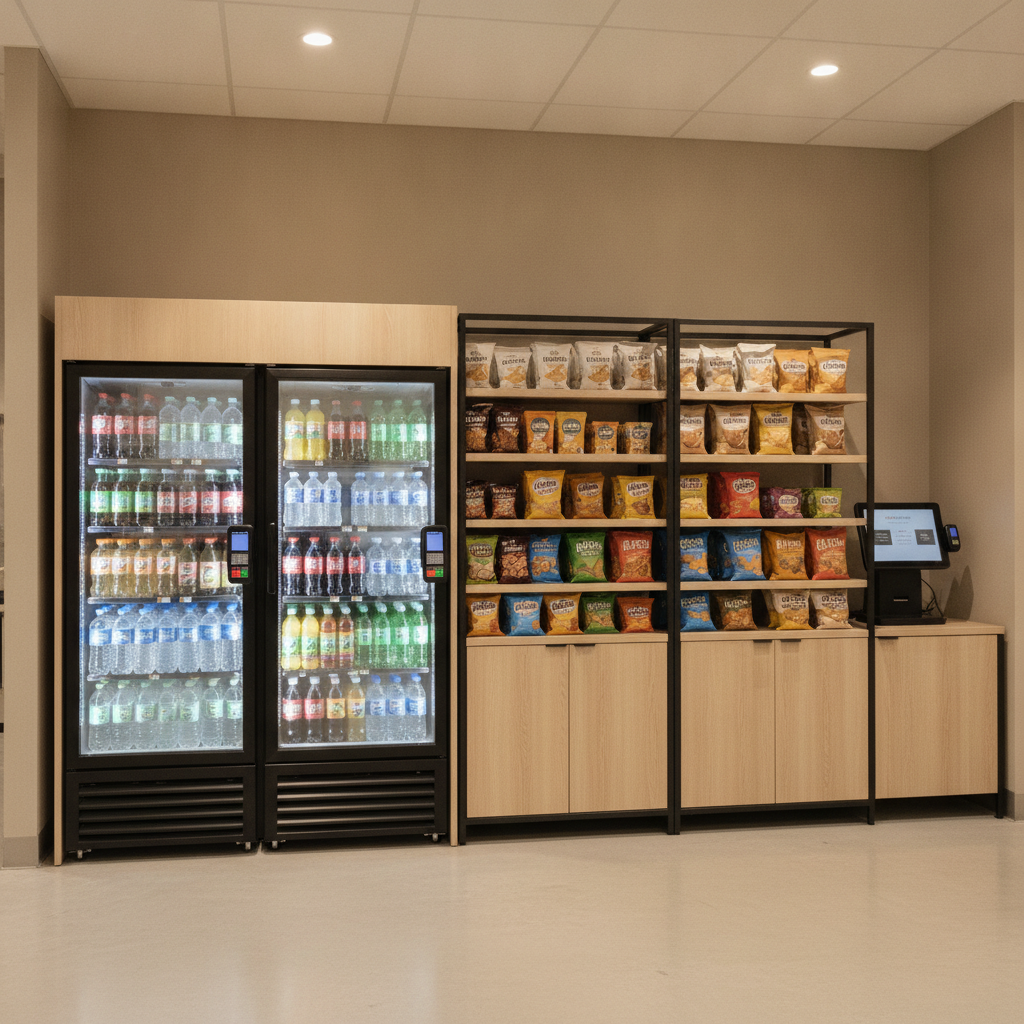
A smart cooler looks like the glass-door fridge at a nice bodega. You tap a card or phone, the door unlocks, you grab a cold brew, a Greek yogurt, or a protein bar, and the door relocks. No coils, no keypad, no waiting. A micro market takes this further, combining smart coolers with open shelving for snacks and a single self-checkout kiosk — essentially a small convenience store tucked into the break room.
Why This Matters for NJ and NYC Workplaces
The workplace evolution across our region has been dramatic. A property manager in Cliffside Park running a mixed-use building today competes with amenity-rich towers in Jersey City and Long Island City. A law firm in Midtown competes with hybrid schedules that let associates work from home. The office snack — once an afterthought — has become part of the reason people come in on a Tuesday.
What we see across Bergen County, Hudson County, and the boroughs:
- Coworking spaces in Williamsburg and Jersey City use micro markets as a differentiator when leasing desks.
- Class A office buildings in Hoboken install smart coolers on multiple floors to reduce elevator trips and keep tenants happy.
- Manufacturing and logistics facilities along the Meadowlands use 24/7 smart coolers because coin-op machines never fit shift workers who wanted real food at 2 a.m.
- Medical offices in Fort Lee and Englewood place smart coolers in waiting areas and staff lounges alike.
What Changed Under the Hood
The single biggest shift is data. Modern equipment reports inventory in real time, so restocks match actual consumption. That’s why today’s break room can carry fresh sandwiches, cold-pressed juice, and better-for-you snacks alongside the classics — waste is managed by the operator, not the office manager. It’s also why full-service programs can be offered at no cost to the host location: the numbers finally work.
Where It Goes Next
The candy bowl isn’t dead — you’ll still find one at plenty of front desks in Ridgewood and on the Upper East Side. But the center of gravity has shifted. The office snack is no longer a small courtesy; it’s a workplace amenity that reflects how a company treats its people. Sixty years from candy dishes to tap-to-pay coolers is a long journey, and it’s still moving.