
Why Hudson Lights Is a Textbook Micro Market Site
The Hudson Lights development at the New Jersey end of the George Washington Bridge is one of the more interesting food-service puzzles in Bergen County. You have residential towers, Class A office floors, a hotel, and ground-floor retail all stacked on the same block. Foot traffic patterns inside the building don’t match the retail outside — residents want late-night snacks, office tenants want lunch and cold brew between 10am and 2pm, and retail staff want something affordable they can grab in a 15-minute break without crossing Main Street.
For leasing and property managers in Fort Lee, that’s exactly the gap a micro market is built for. One unattended retail footprint, open 24/7, serving three totally different user groups without staffing a café.
What a Hudson Lights Micro Market Actually Looks Like
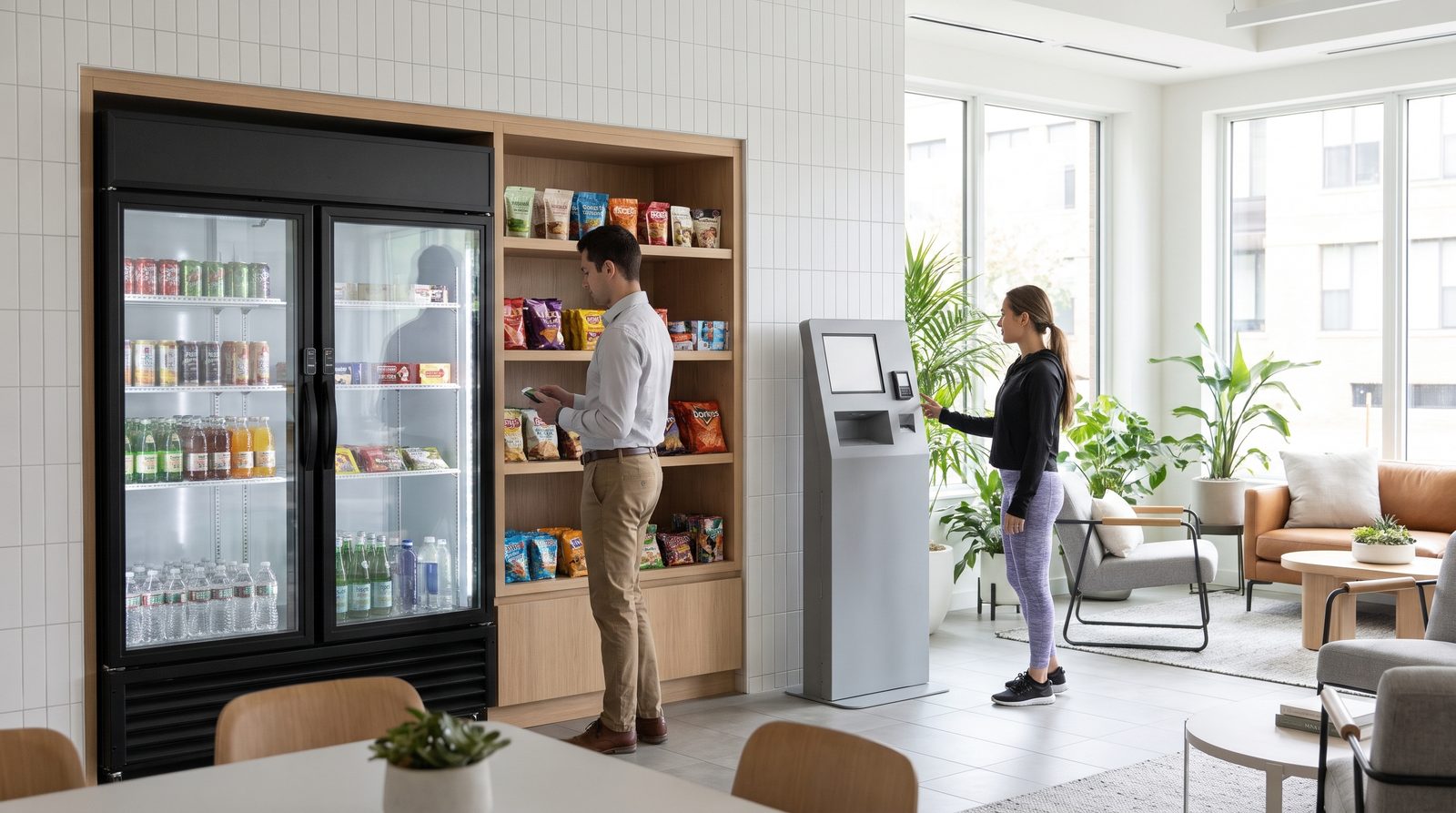
A micro market isn’t a bank of old snack machines pushed into a corner. It’s an open retail area — usually 150 to 400 square feet — with glass-door smart coolers for drinks, fresh food, and dairy, open wood shelving for snacks and shelf-stable items, and a single self-checkout kiosk. Tenants walk in, pick up what they want, tap a card or phone, and leave. There’s no attendant and no locked glass between the customer and the product.
For a mixed-use building like Hudson Lights, the setup usually works best in one of three locations:
- Office lobby or amenity floor — serves tenants in the commercial component during business hours
- Residential amenity lounge — serves residents on evenings, weekends, and late nights
- Loading-dock-adjacent back-of-house — serves retail staff and building engineering teams
The One Insight Most Leasing Decks Miss
Here’s something a generic article won’t tell you: in a true mixed-use building, the product mix should rotate by time of day, not by week. A micro market serving Hudson Lights-style traffic needs cold brew, bowls, and better-for-you grab-and-go stocked heavy for the 10am–2pm office rush, then a planogram shift toward frozen single-serve meals, ice cream, and comfort snacks for the 7pm–midnight residential rush.
Operators who treat a mixed-use site like a straight office location run out of lunch at noon and sit on stale inventory by Friday. The buildings that get this right use remote inventory monitoring to flag which SKUs move at which hours, then restock on a split schedule — morning for lunch items, late afternoon for evening items. If you’re interviewing vending partners, ask them specifically how they handle dayparted demand. If they look confused, they’ve never run a residential-office hybrid.
What Managers at Hudson Lights-Style Properties Should Negotiate
If you’re a leasing or property manager evaluating a micro market for a Fort Lee mixed-use asset, the terms matter more than the equipment list. A few things worth pinning down before you sign:
- Who owns the loss shrink? In an unattended market, there’s always some product loss. A real operator absorbs it and designs the camera coverage around it. Don’t accept a contract that charges shrink back to the property.
- What’s the restock SLA? For a building with residents, a two-day stockout window is unacceptable. Ask for 24-hour response on critical SKUs and remote monitoring that triggers restocks automatically.
- Who handles the kiosk when it glitches? Self-checkout hardware fails occasionally. The operator should own hardware swaps, not the property engineer.
- Is there a hosting fee or revenue share? For most mixed-use buildings in the 300+ unit range, a well-sited micro market pays for itself through sales and runs at no cost to the property.
Fitting the Space Into an Already-Leased Floorplan
The common objection at buildings like Hudson Lights is that the amenity floors are already built out. Micro markets are more flexible than they look. We’ve designed layouts that fit into 120 square feet by using double-stacked smart coolers against a wall and open shelving mounted vertically. The self-checkout kiosk itself has a footprint smaller than a standing desk. If you have a wall, a 20-amp circuit, and reliable Wi-Fi, you have a candidate location.
The Fort Lee Context
Fort Lee’s density around the GWB approach — Hudson Lights, The Modern, Centuria, and the older coop towers along Palisade Avenue — makes it one of the strongest sub-markets in Bergen County for unattended retail. Tenants here are commuters, remote workers, and residents who expect NYC-level convenience without crossing the bridge. A micro market is one of the cheaper ways to deliver that expectation at the building level.
If you manage a mixed-use asset in Fort Lee and want to see what a planogram and layout would look like for your specific floorplan, that’s a conversation worth having before your next tenant amenity review.