
Why Generic Vending Doesn’t Work on Fort Lee’s Main Street
If you’ve walked Fort Lee Main Street between Lemoine Avenue and the base of Bridge Plaza, you know it’s not a typical New Jersey commercial strip. The Korean and Chinese business district here — banks, law offices, medical practices, real estate firms, restaurants prepping for lunch service — operates on rhythms and tastes that a Coke-and-Snickers box on the wall simply doesn’t serve. After operating vending across Fort Lee for several years, we’ve learned that the property managers and restaurant owners who succeed with an unattended food program are the ones who treat product mix as a cultural decision, not a logistics one.
What Fort Lee Break Rooms Actually Ask For
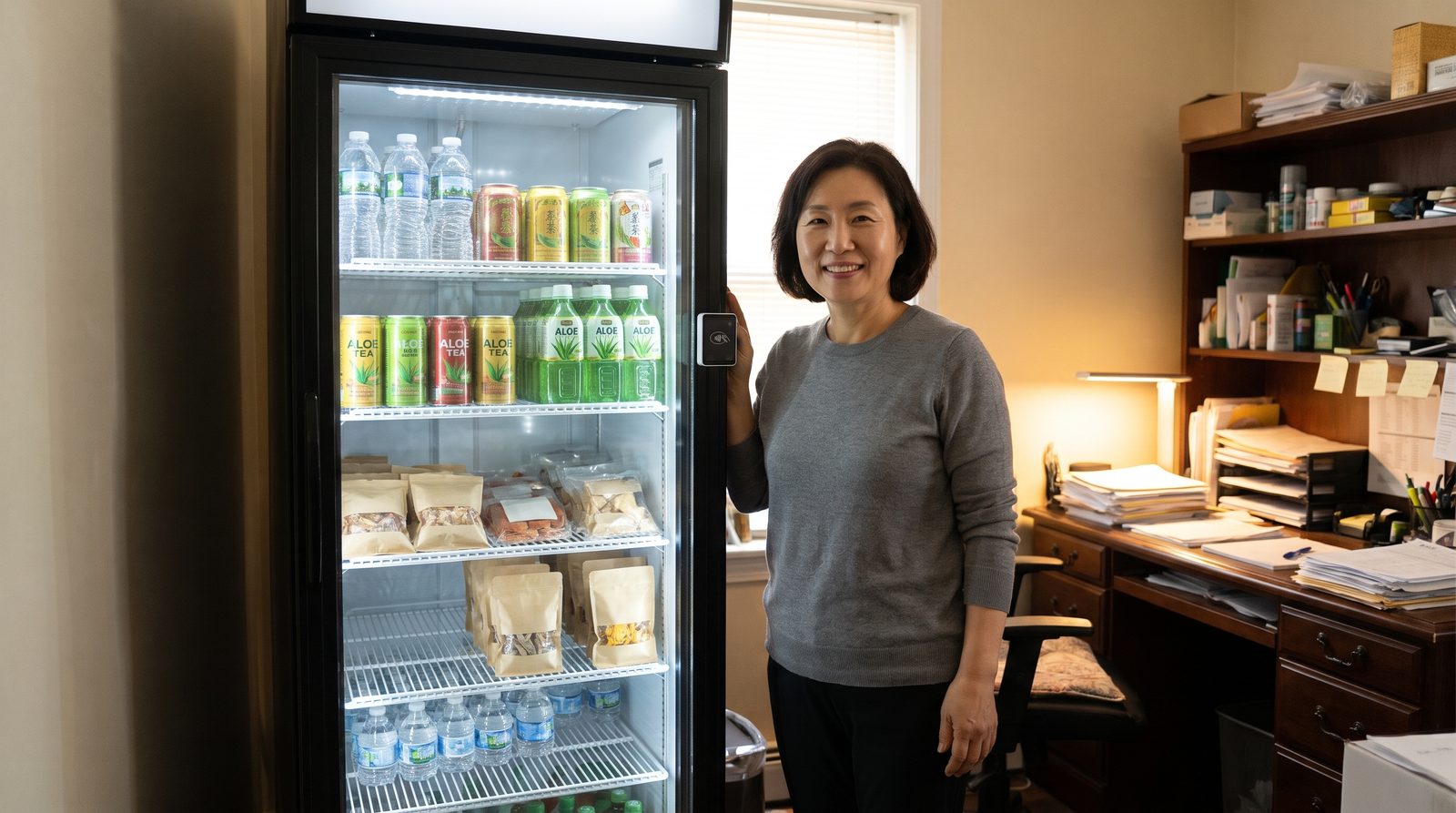
Here’s a specific, actionable insight most vending articles won’t give you: in Fort Lee back-of-house break areas, the top-moving cold SKUs are rarely the national brands you’d expect. We consistently see stronger turns on items like Milkis, Aloe Vera drinks, Pocari Sweat, banana milk, canned barley tea, and Vita Coco — followed by the usual Coke and water. On the snack side, shrimp crackers, Pepero, seaweed snacks, Choco Pie, and Haitai wafers move faster than domestic chip brands in most of the Korean-owned offices we service near Central Road and Main.
If your current vending operator is stocking your break room like a highway rest stop, they’re leaving revenue and satisfaction on the table — and your staff is walking to H Mart or Hannam Chain on their break instead of staying on-site.
The Right Equipment for Small Fort Lee Footprints
Most Fort Lee commercial spaces — the mixed-use buildings along Main Street, the older walk-ups above ground-floor restaurants, the office suites in the Bridge Plaza towers — do not have room for a bank of old-school vending machines with coin slots and spiral coils. They have a corner. Maybe a hallway alcove next to the copier.
That’s why we deploy smart coolers almost exclusively in this market. A single glass-door smart cooler takes the footprint of a standard refrigerator, plugs into a normal outlet, and works like the grab-and-go fridges in a 7-Eleven: tap a card or phone, the door unlocks, take what you want, close the door, and you’re charged for exactly what you took. No buttons. No jammed coils. No “machine ate my dollar” complaints from your tenants.
Where Micro Markets Fit
For the larger properties — the medical buildings on Central Road, the multi-tenant office floors near the GWB approach, and a few of the newer residential towers with commercial ground floors — a full micro market makes more sense. That’s an open retail setup: two or three smart coolers next to open wood shelving for shelf-stable snacks and instant noodles, with one self-checkout kiosk handling payment. Tenants shop it like a tiny convenience store. We’ve found that Fort Lee micro markets do especially well when we stock cup ramyun, instant rice bowls, and a rotating selection of Korean bakery-style snacks alongside the standard American options.
What Property Managers and Restaurant Owners Should Ask For
- Bilingual product labeling and receipts. Our system supports English receipts by default, but the on-cooler product tags should reflect what your tenants actually recognize.
- Contactless-only payment. Cash handling in a small break room is a liability. Tap-to-pay covers Apple Pay, Samsung Pay, KakaoPay-linked cards, and standard credit — which is what your staff is already using.
- A product mix conversation, not a template. A restaurant owner staffing a kitchen through dinner service has different break-room needs than a law office. Ask your operator what they’ll change on the second restock based on what didn’t sell.
- Remote monitoring. You should never be the one calling the vending company to say the cooler is empty. Our coolers report inventory in real time, and restocks are scheduled off actual sales data — not a rigid weekly route.
Cost to the Property
For most Fort Lee locations that meet our headcount and foot-traffic thresholds, the service is placed at no cost to the property. We own the equipment, we handle the stocking, we handle the service calls, and tenants pay per item at the cooler. That’s the model — no lease, no utility surcharge beyond the outlet the cooler is plugged into.
Getting Started
If you manage a building along Main Street, Lemoine, Central Road, or anywhere in the Bridge Plaza area, the honest first step is a walk-through. We look at the space, count the daily headcount, ask what your tenants are actually eating and drinking now, and tell you whether a single smart cooler or a full micro market fits. Sometimes the answer is that the space isn’t right yet — and we’ll tell you that too.