
The coin jar is dead. Here’s what replaced it.
If you’re running an office in Hackensack, Paramus, or Fort Lee and your break room still has a machine that eats dollar bills half the time, you already know the calls you get. “It took my money.” “It didn’t vend.” “Do you have change for a five?” Cashless vending solved most of that — but only if it’s set up correctly. After years of installing equipment across Bergen County corporate offices, here’s what office managers actually need to know before signing anything.
What “cashless” really means in 2025
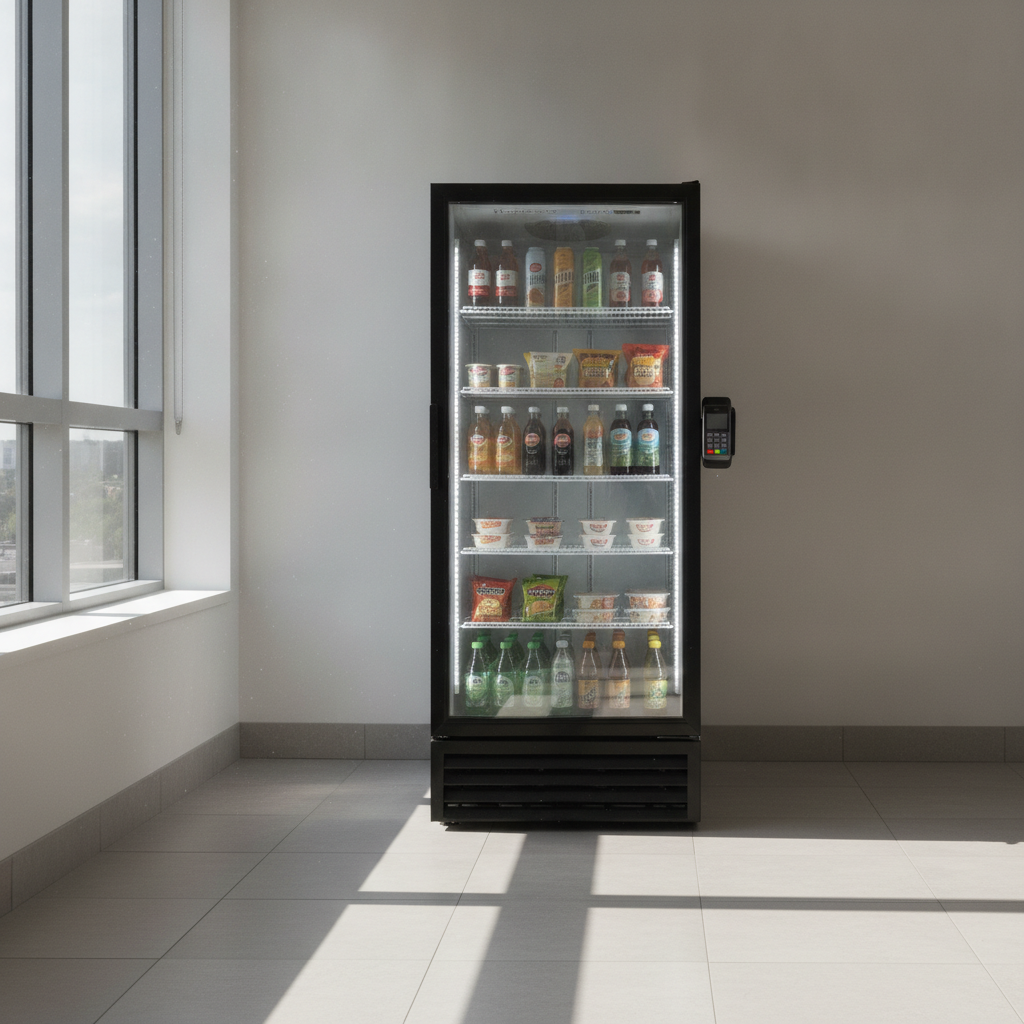
A modern cashless vending machine isn’t just a credit card slot bolted onto an old machine. In our smart coolers, the payment terminal is a small contactless reader mounted on the door frame. An employee taps their phone or card, the door unlocks, they grab a drink or snack, and the door re-locks. The system weighs and sees what left the cooler and charges only for that. No selection buttons, no spiral coils, no jammed items.
The practical difference for your team:
- No misvends. If the door doesn’t open, no charge posts. Period.
- Faster transactions. Under three seconds from tap to open.
- Real product variety. Fresh salads, yogurt, and cold brew fit on the same shelves as sodas — impossible in a coil machine.
Payment methods your employees expect
At minimum, any operator you talk to should support Apple Pay, Google Pay, tap-enabled credit and debit cards, and chip cards as a fallback. If they’re still pitching machines that require downloading a proprietary app to pay, walk away. Nobody in a Paramus law office is downloading a vending app to buy a Diet Coke.
The five questions Bergen County office managers should ask
1. Who pays the transaction fees?
Every cashless swipe carries a processing fee. A good operator absorbs this into their pricing model — you should never see a line item for it, and your employees shouldn’t see a surcharge at checkout. If a vendor is passing card fees onto users, prices feel punitive and usage drops.
2. How is the machine monitored?
Cashless equipment should be connected. That means remote inventory visibility, temperature alerts on coolers, and payment system health checks. When something goes wrong at 2 a.m. in an Englewood Cliffs office, the operator should know before your first employee arrives. Ask specifically: “Do you get an alert if the payment reader goes offline?”
3. What happens when a charge is disputed?
Occasionally a card gets charged and the employee swears they didn’t get the item. Your operator should have a refund process that doesn’t require you — the office manager — to mediate. A quick email or text with the transaction time, and the refund posts within a day or two. If the answer involves paperwork, that’s a red flag.
4. Is there a minimum headcount or purchase volume?
This matters a lot for smaller offices in mixed-use buildings around Rutherford or Cliffside Park. Some operators won’t install unless you have 75+ employees on-site daily. Smaller footprints work fine with a single smart cooler — you just need a partner who’ll actually service that size location. You can see how we structure this on our services page.
5. What’s the product mix flexibility?
Cashless machines let you sell things a cash machine never could — $8 protein bowls, cold-pressed juices, better coffee. Ask if you can request specific items your team wants. If the answer is “we stock what our route driver has,” you’re getting a generic experience.
What Bergen County offices tend to underestimate
Two things surprise clients most often:
- Cashless increases spend per employee, but not the way you’d think. It’s not that people impulse-buy more — it’s that they stop skipping the machine when they don’t have cash. A colleague grabbing an afternoon kombucha because it’s easy is worth more to your culture than a stocked but ignored machine.
- The building matters. Older Class B buildings in places like Lyndhurst sometimes have spotty cell signal in interior break rooms, which affects payment terminals that rely on cellular connectivity. A good installer will do a signal check before mounting anything and switch to a Wi-Fi-backed unit if needed.
The one-line summary
Cashless vending isn’t a feature — it’s the baseline. The real questions are about who covers fees, how fast issues get resolved, and whether the product mix actually matches your team. Get those right and the machine becomes something employees are glad exists. Get them wrong and it’s just a taller, shinier version of the machine that ate their dollar bill.