
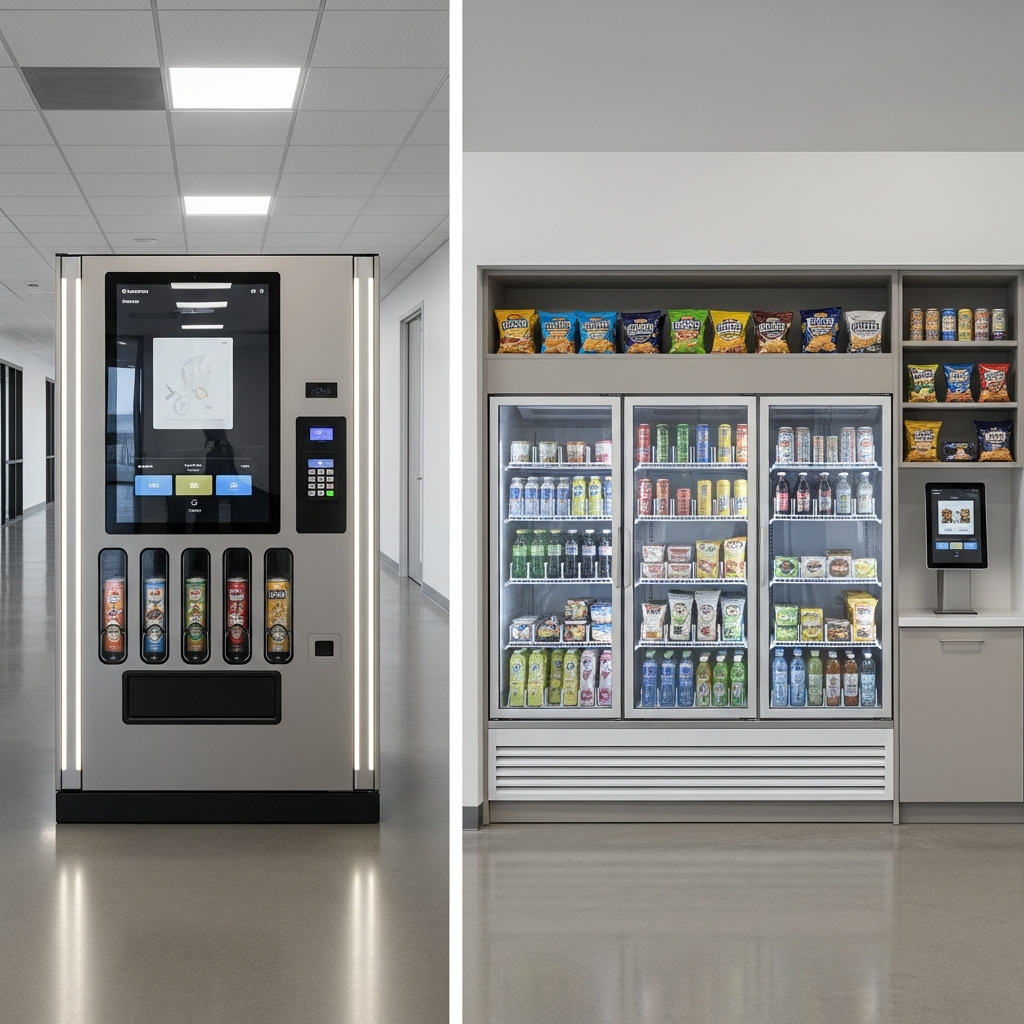
One of the first questions I get from office managers in Hackensack, Jersey City, and Fort Lee is the same: what’s this going to cost us? The honest answer surprises most people. For the majority of small and mid-size offices, the out-of-pocket cost is zero. But there’s nuance worth understanding before you sign anything, because not every office qualifies for free placement, and not every operator structures deals the same way.
The Three Main Ways Vending Machines Get Paid For
When you ask about vending machine cost for an office, you’re really asking about one of three arrangements. Each makes sense in different situations.
1. Free Placement (Operator-Owned)
This is the most common setup. A vending operator like us installs and stocks the machine at no charge. We own the equipment, handle restocking, repairs, refunds, and product rotation. Employees pay per item using card, mobile wallet, or cash. The office pays nothing.
The catch: operators need enough foot traffic to justify the route stop. For a single smart snack and beverage machine, we typically look for 40+ regular employees on-site or a building with multiple tenants sharing a break room. A 12-person law office in Cliffside Park usually won’t qualify on its own, but if it’s in a shared floor with two other tenants, it absolutely can.
2. Subsidized or Partially Subsidized
Some offices want premium products (cold brew, organic snacks, protein bars, kombucha) that don’t sell fast enough to support the machine on their own. In that case, the employer covers a portion, usually $50–$200 per month, to either subsidize prices for staff or guarantee certain inventory. We see this a lot with tech and finance offices in Hoboken and along the Jersey City waterfront where employee perks are a recruiting tool.
3. Purchased Outright
If you want to own the machine, run it yourself, and keep the revenue, a new smart vending machine with touchscreen and contactless payment runs $4,000–$8,000. A combo snack/drink machine is closer to $5,500. Used machines start around $1,500 but often need card reader upgrades ($400–$600) to accept modern payment. Then you’re on the hook for product sourcing, restocking, expired inventory, and service calls. Most small business owners try this once and call an operator the next year.
What Actually Drives the Cost Decision
From running routes across Bergen and Hudson County, here’s what I’ve learned matters most:
- Headcount on-site, not total payroll. A 60-person company where 45 work hybrid two days a week behaves like a 25-person office for vending purposes.
- Building type. Class A office towers in Jersey City with shared lobbies are different from a converted warehouse in Carlstadt with one tenant. Multi-tenant buildings often justify a micro market where a single-tenant office of the same size only justifies a machine.
- Existing food options. If there’s a deli on the ground floor of your Englewood Cliffs building, vending sales drop maybe 30–40%. That changes the math on whether free placement works.
- Power and space. A standard machine needs a dedicated 110V outlet and about 40 inches of width. Older buildings in Union City sometimes need an electrician visit before install, which the operator typically doesn’t cover.
Real Examples From NJ Offices We Serve
A medical office building in Paramus with around 80 daily staff across three practices: free placement, smart combo machine, zero cost to the building. A boutique creative agency in Weehawken with 22 employees: didn’t qualify for free placement alone, but joined with two neighboring suites to share a small micro market. A logistics warehouse in Secaucus with 110 workers across two shifts: free placement plus a coffee setup, no monthly fee.
The pattern is straightforward. If your office has the traffic, you pay nothing. If it doesn’t, there’s usually a creative way to make it work, whether that’s a subsidy, sharing with neighbors, or starting with a smaller footprint and growing.
Hidden Costs to Ask About
Even with free placement, ask any operator these questions before signing:
- Who pays for electricity? (Always the office, but it’s typically $15–$25/month per machine.)
- What’s the response time on refunds and service?
- Is there a minimum sales threshold? Some operators pull machines if monthly revenue drops below a number.
- Can you request specific products?
- What happens if a product expires? (It should be the operator’s problem, not yours.)
If you want a straight answer about what your specific office qualifies for, take a look at our vending and micro market services or reach out directly. We’ll tell you honestly whether free placement makes sense or whether you’re better off with a different setup. No pitch, just numbers.