
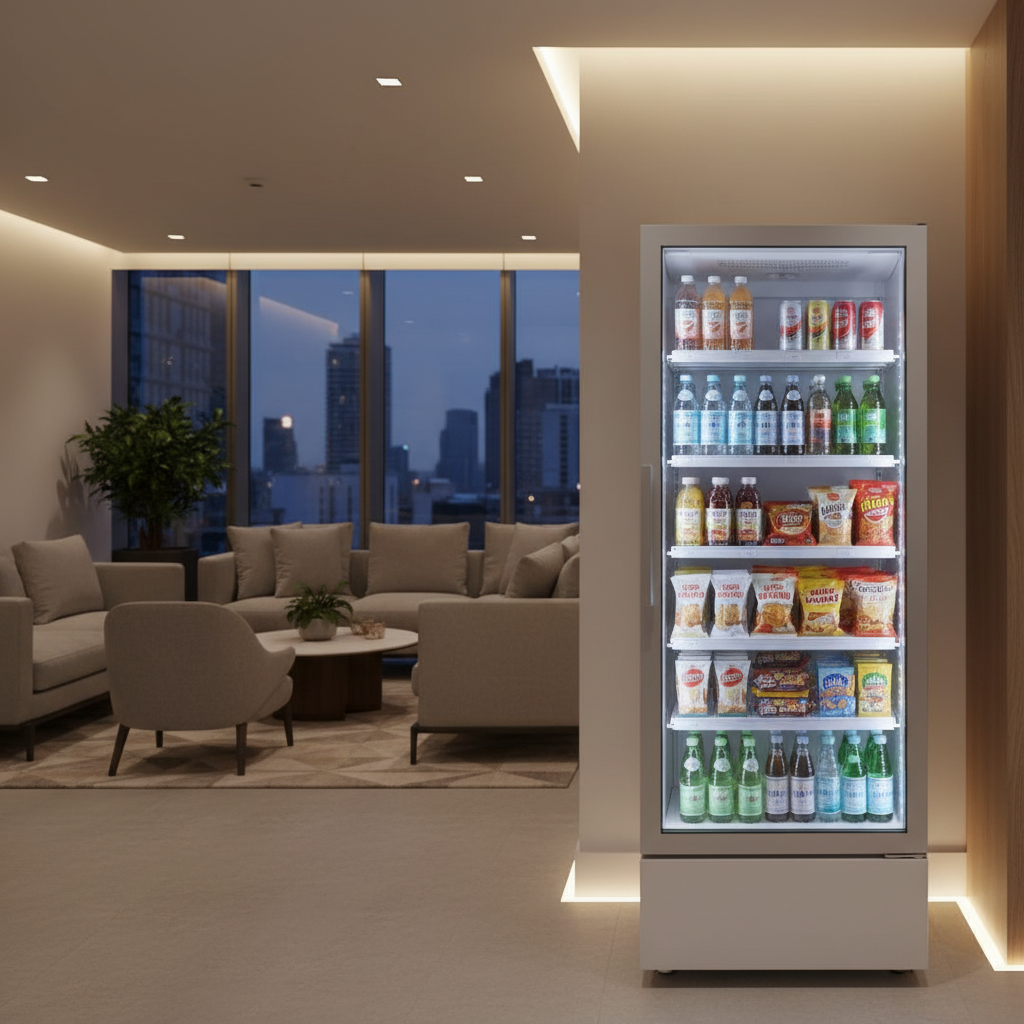
If you manage a medical office in Bergen County, you’ve probably had the same conversation more than once: staff coming back from lunch with cold pizza, residents on a 12-hour shift skipping food entirely, and patients in the waiting room asking where they can grab a water. The break room question keeps coming back, and now you’re weighing whether to install a couple of vending machines or go all-in on a micro market.
Both options work in medical settings — but they work for very different buildings. After installing equipment in offices along Prospect Avenue in Hackensack and the Cedar Lane corridor in Teaneck, here’s how I’d think through the decision.
The Core Difference (Beyond the Sales Pitch)
A vending machine is a sealed, self-contained unit. Staff or visitors pay at the machine, a product drops or rolls out, done. Modern smart vending units take tap-to-pay, mobile wallets, and badge payment.
A micro market is essentially an open convenience store — open coolers, shelving, and a self-checkout kiosk. Anyone in the space can pick up items, read labels, check expiration dates, and pay at the kiosk.
For medical offices specifically, that openness is the deciding factor — in both directions.
When Vending Wins in Medical Settings
Mixed-Access Buildings
The medical office buildings in Hackensack near Hackensack University Medical Center share lobbies, elevators, and hallways with patients, family members, delivery drivers, and lab couriers. A micro market in a shared corridor is a shrinkage problem waiting to happen. Sealed vending equipment makes more sense when you can’t control who walks past.
Smaller Headcounts
If your suite has 15–40 employees, a micro market is overbuilt. Two smart vending machines — one snack/sundry, one cold beverage and grab-and-go — cover the demand without needing the square footage a market requires.
Off-Hours and Weekend Coverage
Urgent care and imaging centers running extended hours need 24/7 reliability. Vending is the simpler answer when there’s no reception staff after 7 PM and you don’t want a market sitting open and unsupervised.
When Micro Markets Win
Larger Single-Tenant Medical Offices
Several of the larger Teaneck practices on Cedar Lane and DeGraw Avenue have 75+ employees in a secured, badge-access space. That’s the sweet spot for a micro market. You get refrigerated salads, fresh sandwiches, yogurt parfaits, fruit cups — the kind of selection clinical staff actually want when they’re working through lunch.
Recruiting and Retention
Medical assistants and techs compare benefits between practices. A micro market with fresh food reads as a real amenity in a way that a snack machine doesn’t. For groups competing with hospital systems for talent, that perception matters.
Healthier Inventory
Markets allow open coolers, which means you can stock items that don’t survive a vending coil — bento boxes, hummus packs, hard-boiled eggs, cold-pressed juice. In a healthcare setting, the optics of healthier options in the break room aren’t nothing.
The Specific Insight Most Articles Miss
Here’s something you won’t get from a generic comparison: HVAC and floor drainage matter more than you think for either option. Medical offices are often built out for exam rooms, not break rooms. I’ve walked into Bergen County suites where the planned vending corner has no dedicated 20-amp circuit, sits under a return vent that drips condensation, or has no nearby floor drain if a cooler ever fails.
Before you commit to either model, check three things:
- Dedicated circuit: A refrigerated unit or market cooler bank needs its own 20-amp line. Sharing with the autoclave room is a service-call factory.
- Floor surface: Sealed vinyl or tile, not carpet. Carpet under a cold unit gets ugly fast.
- Delivery path: Can a hand truck get from the loading area to the break room without crossing a clinical corridor during patient hours? This affects restocking schedules.
If any of these are wrong, fix them before installation — not after.
A Practical Recommendation Framework
- Under 40 staff, mixed access: Two smart vending machines.
- 40–75 staff, secured suite: Vending plus a small grab-and-go cooler.
- 75+ staff, badge-access break room: Full micro market.
- Multi-tenant medical office building: Vending in the shared lobby, optional market inside individual large suites.
Cost Structure for office vending bergen county Buyers
For most Bergen County medical offices we work with, equipment is placed at no cost when volume supports it. Service, restocking, and repairs are on the operator. You’re not buying machines — you’re hosting them. The decision is really about what fits your space, your staff size, and your access model.
If you want a walkthrough of your suite before deciding, that’s what we do. You can see the full range on our services page, or just reach out directly and we’ll come look at the space. Hackensack, Teaneck, Englewood, Fort Lee — anywhere in the county is a short drive from Cliffside Park.